Alice Rumbold
My PolicemanAlice Rumbold is a pupil in Marion Taylor’s class whose first appearance establishes her as a challenge to Marion’s authority. Marion remembers her as the student who held her gaze instead of looking away, and later recalls her as a recurring source of difficulty. The recollections reveal little about Alice beyond her behaviour and appearance; their significance lies chiefly in what they show about Marion’s early uncertainty as a teacher and her later, rueful amusement.
First Day in the Classroom
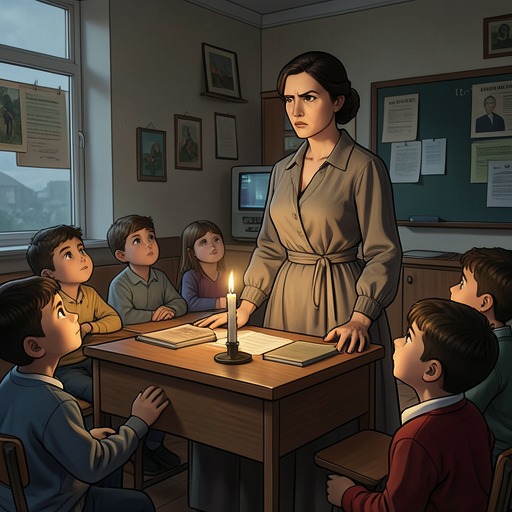
On Marion’s first day, she tries to fix her eyes on the Virgin above the classroom door rather than look directly at the rows of pupils. But twenty-six pairs of eyes face her, and one encounter stays with her. Alice sits in the back row with a dirty-looking bow in her hair, her arms tightly crossed and deep lines bracketing her mouth. When Marion catches her eye, Alice does not look away, unlike the other pupils.
Marion considers ordering Alice to uncross her arms, then decides against it. She thinks there will be plenty of time to deal with girls like her. Writing about the moment later, however, Marion admits that she wishes she had not let Alice get away with it on that first day. The recollection turns a small classroom hesitation into a lasting marker of Marion’s early approach to discipline: she recognizes the challenge, but postpones acting on it, and later interprets that pause as a mistake.
Encounters with Marion
Alice reappears on Queen’s Park Terrace when Marion is speaking with Tom Burgess, who has returned after almost three years away and says he heard from Sylvie that Marion had started teaching there. Alice pushes past them, singing a greeting to Miss Taylor. Marion tries to compose herself, tells Alice not to run, and keeps her gaze on the girl’s shoulders as she turns back to ask Tom what he is doing there. The brief interruption places Alice inside a charged reunion: Marion’s attention is divided between the pupil she is trying to manage and Tom, whose unexpected presence unsettles her.
Alice’s classroom behaviour remains a subject of complaint later. Walking with Julia Harcourt, Marion begins to describe Alice as difficult, and Julia supplies a blunt word for her, prompting Marion to laugh. Julia concludes that Marion needs hooves to deal with Alice. The exchange makes clear that the first-day incident was not an isolated memory: Alice continues to test Marion’s patience. It also shows Marion discussing the strain with a friend in a joking register rather than presenting it solely as a matter of formal discipline.
Characterization and Narrative Role
Alice is drawn through Marion’s selective attention. The account lingers on her face, bow, posture, and steady gaze, details that make her conspicuous among the twenty-six pupils before she has done anything more than refuse to look away. Marion’s immediate impulse to correct her is followed by restraint; the later admission of regret gives that restraint a consequence in memory, even though the account does not describe what Alice’s crossed arms meant or how she understood the encounter.
Her later greeting and Marion’s complaint supply the limited but telling continuation of this portrait. Alice appears both as a pupil who disregards Marion’s expectations and as a familiar enough presence to become the subject of an affectionate joke between Marion and Julia. The contrast between Marion’s first-day seriousness and her later laughter keeps the recollection from reducing Alice to a simple adversary: she remains a source of friction, but also part of the ordinary texture of Marion’s teaching life.